
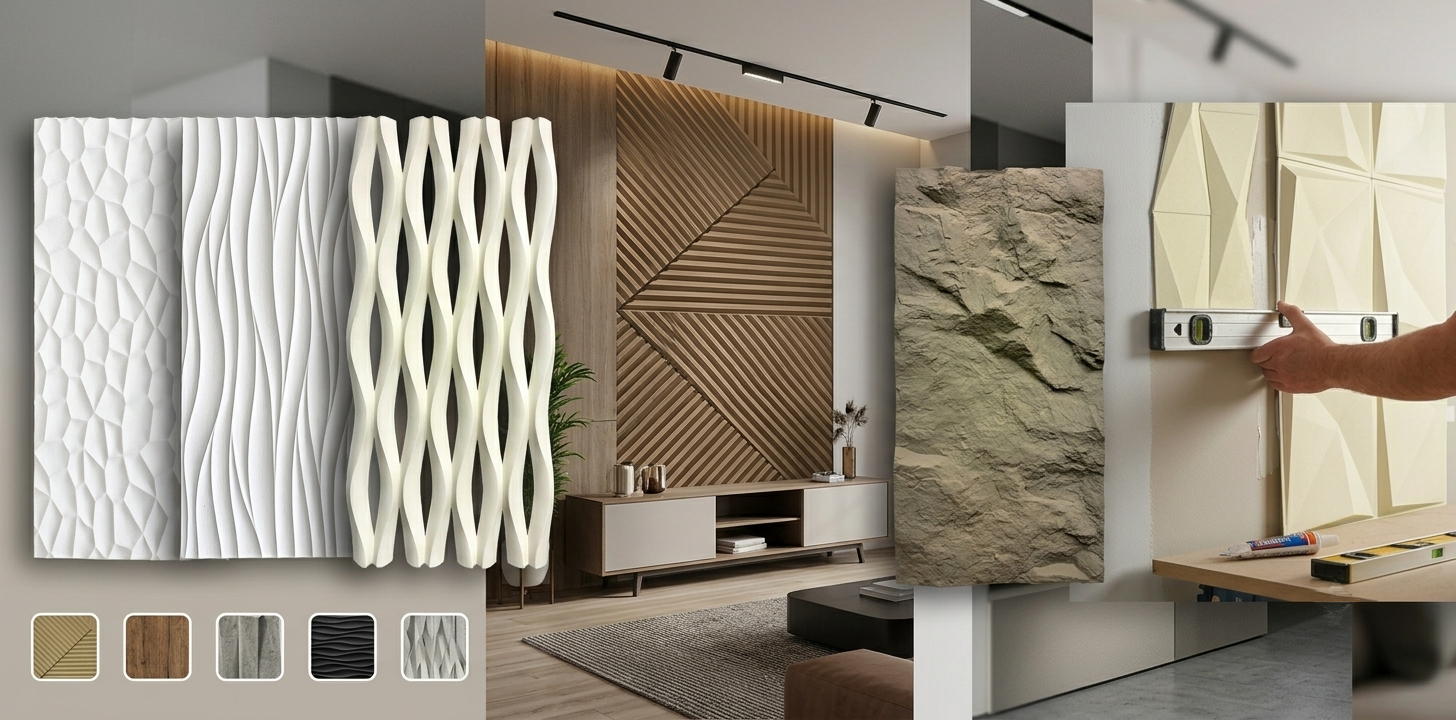
3D Wall Panels: What They Are, Types and How to Install Them Correctly
What Are 3D Wall Panels and How Do They Work?
Unlike flat cladding, a 3D wall panel works with relief: it creates shadows and highlights that shift with the angle of the lighting and give the wall a presence that no wallpaper pattern or paint can replicate. The visual effect is greatest when light strikes the surface at a grazing angle.
What Are They Actually Used For?
- Hiding unevenness on old walls without replastering
- Creating a feature wall without construction works
- Adding light thermal insulation on exterior-facing walls (PU, EPS)
- Mildly improving sound absorption (foam, cork, PET)
- Protecting walls in high-traffic areas from impacts (PVC, lacquered MDF)
Types of 3D Wall Panels by Material
Plaster / Stucco
The most elegant and customisable finish. Can be painted any colour. Impact-sensitive. Interior only. Medium to high weight (8–14 kg/m²). Most common in high-end interior design.
PVC / Plastic
Lightweight, waterproof and impact-resistant. Suitable for bathrooms and kitchens. Wide pattern range. Less premium finish than plaster. Easy DIY installation.
Lacquered MDF
Medium-density fibreboard with routed relief. Very clean finish, contemporary look. Interior only, moisture-sensitive. Requires sanding and painting after installation.
Bamboo / Natural fibre
Organic, warm aesthetic. Sustainable. Good impact resistance. Requires water-repellent treatment for wet areas. Low weight (2–4 kg/m²).
Composite stone
Blend of stone powder and resin. Very realistic mineral appearance. Higher weight (10–18 kg/m²). Suitable for interior and sheltered exterior. Difficult to cut on site.
Polyurethane (PU)
Very lightweight, impact and moisture-resistant. Imitates wood, stone or plaster with good fidelity. Easy to cut and bond. UV-treated versions suitable for exterior. The most versatile material.
| Material | Weight (kg/m²) | Interior | Exterior | Wet areas | Approx. price/m² |
|---|---|---|---|---|---|
| Plaster / Stucco | 8–14 | ✓ | ✗ | ✗ | 25–55 € |
| PVC | 1.5–3 | ✓ | Some | ✓ | 12–28 € |
| Lacquered MDF | 6–10 | ✓ | ✗ | ✗ | 20–45 € |
| Bamboo / Natural fibre | 2–4 | ✓ | Sheltered | With treatment | 18–40 € |
| Composite stone | 10–18 | ✓ | ✓ | ✓ | 35–80 € |
| Polyurethane (PU) | 1–2.5 | ✓ | UV-treated | ✓ | 18–50 € |
Advantages and Disadvantages of 3D Panels
✓ Advantages
- Visual transformation without construction works
- Hide wall imperfections and unevenness
- Wide range of patterns and materials
- Installation in a few hours
- Paintable in any colour (plaster, MDF)
- Compatible with drywall
- Very different effect depending on lighting
- Some suitable for exterior use
- Lightweight options for ceilings
✗ Disadvantages
- Reduced effect without grazing light
- Deep relief can be hard to clean
- Joints between panels can be visible
- Plaster and MDF are impact-sensitive
- Requires a flat and dry substrate
- Not all are suitable for wet areas
- Removal may damage the base wall
Installation Difficulty Level
Step-by-Step Installation of 3D Wall Panels
- Surface preparation
The wall must be clean, dry and dust-free. Fill any unevenness over 5 mm with filler or levelling compound before installation.
- Design planning
Mark a horizontal reference line with a spirit level and plan the panel layout on paper before bonding. Decide whether panels will be installed horizontally, vertically or diagonally.
- Adhesive application
MS-polymer construction adhesive or material-specific adhesive. For plaster panels, bonding plaster or compound can also be used. Apply in a bead around the perimeter and points in the centre according to panel weight. For lightweight PVC and PU panels, spray or gun-applied contact adhesive works well.
- Positioning and levelling
Start from the centre of the wall or from a corner, depending on the pattern. Use a spirit level or laser on every row. Press firmly for 30–60 seconds and use wedges or double-sided tape for temporary fixing.
- Cuts and adjustments
PVC and PU: cutter and straightedge or jigsaw. MDF: circular saw or mitre saw. Plaster: plaster saw or angle grinder with thin cutting disc. Composite stone: angle grinder with diamond blade (wet). Always cut on the back face of the panel.
- Joint treatment
Fill joints between panels with acrylic filler or joint compound, sand once dry. For plaster panels, fill with matching plaster and sand flat. This step makes the biggest quality difference to the final result.
- Primer and painting (where applicable)
Plaster and MDF panels must be primed with a deep penetrating primer before painting. Apply at least two coats of emulsion paint with a short-pile roller. The paint colour completely changes the relief perception.
Lighting for 3D Panels: Getting the Best Out of Them
Lighting is not an optional extra: it is part of the system. A well-lit 3D panel multiplies its effect; poorly lit, it loses it almost entirely.
- Grazing LED strip from above: the most effective option. Recommended colour temperature: 2,700–3,000 K (warm white) for organic reliefs; 4,000 K (neutral white) for geometric designs.
- Ceiling spotlights: allow precise control of the angle of incidence. Common in hospitality and retail projects.
- Upward LED strip from below: interesting upward effect in hallways and corridors.
- Natural grazing light: when the wall is perpendicular to a window, natural morning or evening light can deliver the best result without artificial lighting.
3D Wall Panel Prices
- Basic PVC: 10–18 €/m²
- Polyurethane stone/brick imitation: 18–45 €/m²
- Lacquered MDF: 20–45 €/m²
- Plaster / Stucco: 25–55 €/m²
- Bamboo / Natural fibre: 18–40 €/m²
- Composite stone: 35–80 €/m²
Comparison: 3D Panels vs Other Wall Solutions
| Solution | Visual effect | Installation | Reversibility | Approx. price/m² |
|---|---|---|---|---|
| 3D wall panel | High — real relief | No building works | Medium | 10–80 € |
| Textured wallpaper | Medium — flat texture | No building works | High | 8–35 € |
| Effect paint | Low–medium | No building works | High | 5–20 € |
| Flexible natural stone | High — real mineral | No building works | Low | 30–80 € |
| Ceramic cladding | High — permanent | Requires building works | Very low | 25–90 € + fitting |
Frequently Asked Questions About 3D Wall Panels
Can 3D panels be mounted on tiles?
Yes, as long as the tiles are well bonded and the surface is flat. Apply construction adhesive directly onto a clean, degreased tile surface. PVC and PU panels are best suited due to their low weight.
Can 3D wall panels be painted?
Yes, plaster, stucco and MDF panels are specifically designed to be painted. A deep primer and emulsion paint are recommended. PVC and PU can be painted with acrylic paint, but the result is less durable.
Are 3D panels suitable for the bathroom?
Only PVC and polyurethane. Plaster, MDF and bamboo deteriorate with prolonged moisture. In the shower area where water falls directly, use a fully waterproof system.
What adhesive should I use for 3D panels?
For lightweight PVC/PU: spray contact adhesive or gun-applied construction adhesive. For plaster: bonding plaster or compound. For composite stone: C2-rated tile adhesive or heavy-duty adhesive.
Are the joints between panels visible?
With proper joint treatment (filling, sanding, two coats of paint) joints are virtually invisible. Patterns with continuous relief hide joints better than geometric ones with straight lines.
Can 3D panels be mounted on the ceiling?
Yes, but only with very lightweight materials: PVC or polyurethane. On the ceiling, always add mechanical fixings as well. Plaster or composite stone are too heavy without mechanical fastening.
How much does installing 3D wall panels cost?
Materials range from 10–18 €/m² for basic PVC to 35–80 €/m² for composite stone. For a 10 m² wall with painted plaster panels, total material costs are between 320 and 650 €.
How long does installing 3D panels take?
For a 10–15 m² wall with PVC or PU panels, 3 to 5 hours. With plaster panels requiring joint treatment and painting, the process can extend to 2–3 days.
Conclusion
3D wall panels are one of the wall decoration solutions with the best ratio of visual impact to installation effort. The result depends significantly on choosing the right material and planning the lighting. A 3D panel without grazing light loses half its effect. With the right lighting it transforms a room completely — no building works required.
View 3D wall panels → All wall cladding → Talk to an adviser →
Share:
Paneles acústicos de pared: qué son, cómo funcionan y cuándo tiene sentido instalarlos