
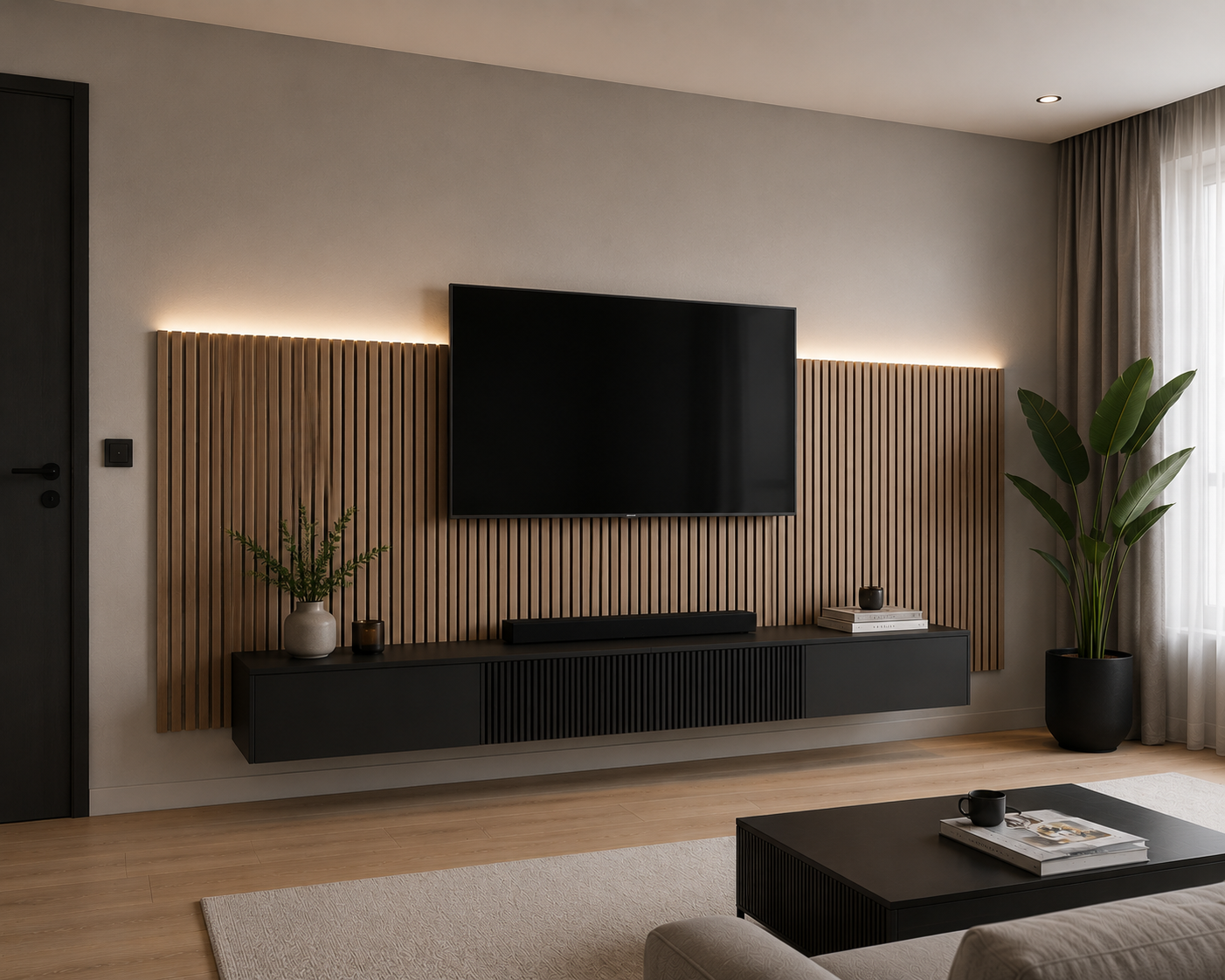
Acoustic Wall Panels: What They Are, How They Work and When It Makes Sense to Install Them
What Are Acoustic Wall Panels?
An acoustic panel is a cladding element made from a porous or fibrous material — melamine foam, mineral wool, polyester fibre, perforated wood — that converts the energy of sound waves into heat through internal friction. The result: part of the sound that would have reflected off the wall is retained within the panel.
The amount of sound absorbed depends on the material, thickness and frequency of the sound. This behaviour is measured with the sound absorption coefficient (α), which ranges from 0 (total reflection) to 1 (total absorption).
Absorption vs Soundproofing: A Fundamental Distinction
This is the most common mistake when searching for acoustic solutions. Wall panels do not soundproof: they do not prevent external noise from entering the room or internal noise from escaping. For that you need mass, airtightness and structural decoupling.
Types of Acoustic Wall Panels
| Type | Material | Application | Typical NRC |
|---|---|---|---|
| Acoustic foam | PU or melamine foam (wedge, pyramid) | Home studio, technical rooms | 0.70–0.85 |
| Polyester fibre (PET) | Recycled pressed PET | Offices, living spaces | 0.75–0.95 |
| Mineral wool + fabric | Mineral wool with fabric wrap | Conference rooms, studios | 0.85–1.00 |
| Perforated wood panel | MDF or solid wood with perforations | Premium interiors | 0.55–0.75 |
| Acoustic diffuser | Profiled wood or plastic | Mastering studios, hi-fi rooms | — (scatters, does not absorb) |
| Cork panel | Natural cork | Light residential use | 0.35–0.45 |
Reading the NRC Coefficient and Choosing Correctly
The NRC (Noise Reduction Coefficient) is the average absorption coefficient between 250 Hz and 2,000 Hz — the range where the human voice concentrates most of its energy. It is the most commonly used value in technical data sheets for offices and general applications.
Structure of a Quality Acoustic Panel
Advantages and Disadvantages of Acoustic Panels
✓ Advantages
- Real and measurable reverberation reduction
- Installation without construction works
- Wide range of decorative finishes
- Compatible with any wall
- Improve speech intelligibility
- Some models fire-retardant (Class B)
- Accessible DIY option
- Improve thermal comfort (mineral wool)
- Removable and reusable
✗ Disadvantages
- Do not block external noise
- Limited effectiveness at low frequencies
- Take up room space
- Calculation needed for good results
- Budget quality degrades in humidity
- Treating only one wall achieves little
- PU foam ages and crumbles over time
Where Are Acoustic Panels Used?
Residential
- Living and dining rooms: high ceilings and hard floors create long reverberation times. Panels on two or three walls reduce echo without compromising aesthetics.
- Children's rooms: reduce listening fatigue and improve concentration.
- Home cinema: side panels and rear wall control first reflections and improve the stereo soundstage.
- Home recording studio or podcast: requires a combination of absorbers and diffusers in calculated positions.
Commercial and Office
- Open-plan offices: panels on ceiling and walls reduce perceived noise levels and improve speech privacy.
- Conference rooms: target reverberation time TR60 between 0.4 and 0.6 seconds.
- Restaurants and bars: excessive reverberation forces people to raise their voices, which increases noise. Panels break this cycle.
- Schools: ANSI standard S12.60 recommends TR60 ≤ 0.6 s in empty classrooms.
Installing Acoustic Panels
1. Direct adhesive bonding
Construction adhesive or neutral silicone on the back of the panel. Quick and without visible holes. Suitable for smooth walls. Disadvantage: removal without wall damage is difficult.
2. Hanging system with rails or hooks
The most professional and versatile system. A rail or hook system is fixed to the wall and the panel hangs from it. Allows repositioning without marks. Some rail systems allow wall-offset mounting, which improves low-frequency absorption.
3. Mechanical fixing (screws)
For heavy panels (mineral wool with wooden frame). The frame is fixed directly to the wall with wall plugs and screws. Permanent but very solid.
Formats, Dimensions and Thicknesses
| Type | Typical format | Thickness | Weight approx. | Typical NRC |
|---|---|---|---|---|
| Foam wedge/pyramid | 50 × 50 cm | 3–10 cm | 0.5–1 kg/m² | 0.70–0.85 |
| PET fibre board | 60 × 120 / 120 × 240 cm | 9–12 mm | 1.5–2.5 kg/m² | 0.75–0.95 |
| Mineral wool + fabric | 60 × 120 / 60 × 60 cm | 4–10 cm | 8–15 kg/m² | 0.85–1.00 |
| Perforated wood panel | 60 × 120 / 120 × 280 cm | 12–19 mm | 10–18 kg/m² | 0.55–0.75 |
| Bass trap (corner) | 30 × 30 × 120 cm (triangular) | 15–30 cm | 5–12 kg/unit | 0.50–0.80 (<250 Hz) |
Approximate Prices for Acoustic Panels
- Basic acoustic foam: 4–12 €/m²
- PET fibre board: 18–35 €/m²
- Mineral wool with fabric cover: 35–65 €/m²
- Perforated or grooved wood panel: 50–120 €/m²
- Bass traps: 40–90 € per unit depending on material and size
Maintenance and Durability
- PET fibre and mineral wool with fabric cover: lifespan over 20 years under normal indoor conditions.
- Polyurethane foam: 5–10 years before degradation. Not recommended for permanent installations.
- Mineral wool: mineral material, does not degrade. The limiting factor is the textile cover (10–15 years).
- Perforated wood: durability equivalent to any interior wood element. Sensitive to excessive moisture.
Frequently Asked Questions About Acoustic Panels
Do acoustic panels help block neighbours' noise?
No. Acoustic panels are absorbers, not soundproofing. They reduce reverberation inside the room but do not block sound travelling through walls, ceilings or floors. That requires soundproofing: mass, airtightness and structural decoupling.
How many panels do I need to hear a difference?
As a rule of thumb, covering 15–25% of total wall surface (excluding the floor) brings a clearly perceptible improvement in most living spaces. Very reverberant rooms may need 30–40%.
Which is better: foam or PET fibre panels?
For residential or professional use with aesthetic requirements, PET fibre is clearly superior: better absorption, longer-lasting, does not degrade, available in colours and formats. Foam only has a price advantage — and in the long term, not even that.
Can acoustic panels be mounted on the ceiling?
Yes. Hanging ceiling panels (baffles) are very effective because they intercept direct sound before it hits the walls. They require specific suspension systems. Weight is the limiting factor with mineral wool (10–15 kg/m²).
Are acoustic panels fire-resistant?
Depends on the material. Mineral wool is non-combustible (Class A1). PET fibre is usually rated B-s1. Untreated PU foam is flammable: always check the fire classification, especially in public spaces.
Is it better to mount the panel away from the wall or directly bonded?
An air gap always improves low-frequency performance. A 5–10 cm gap between the panel and the wall can significantly increase absorption below 250 Hz without increasing the physical thickness of the panel.
Can acoustic panels be customised in colour and size?
Yes. PET fibre and mineral wool panels with fabric covers are made to measure and available in a wide colour catalogue. Many manufacturers offer custom image prints on the fabric.
How much does an acoustic treatment cost?
For a basic treatment of a 20 m² conference room with PET panels, the material budget is between 400 and 800 €. A semi-professional recording studio may require 1,500 to 5,000 € in materials.
Conclusion
Acoustic wall panels are a technical solution with measurable results. They work within their scope — reverberation reduction and improved speech intelligibility — in a predictable and effective way. Knowing that they do not block noise, understanding the NRC coefficient and planning coverage correctly is enough to achieve genuinely noticeable results without touching a single wall.
View acoustic panels → All acoustic solutions → Talk to an adviser →
Share:
Suelo vinílico SPC: qué es, cómo funciona y cuándo es la mejor opción
Paneles murales 3D: qué son, qué materiales existen y cómo se instalan correctamente