
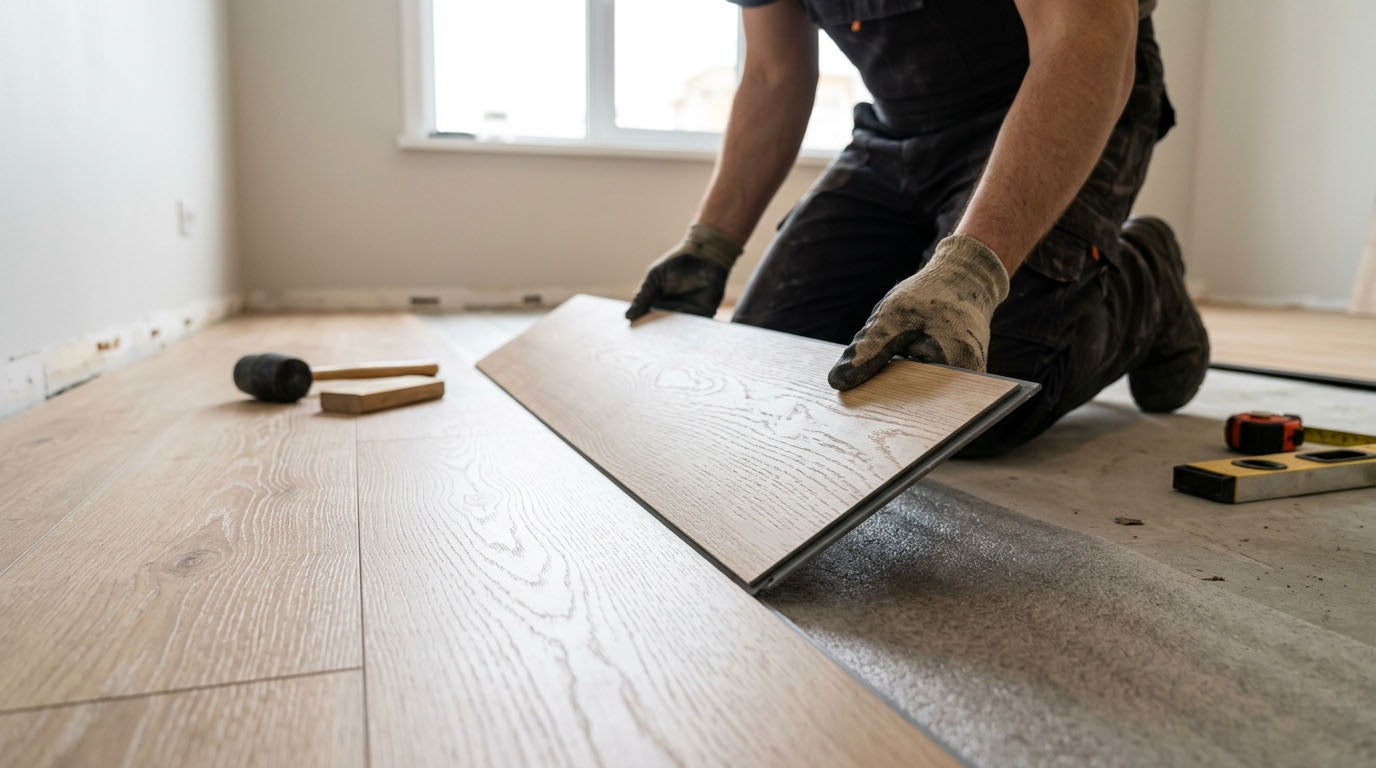
SPC Vinyl Flooring: What It Is, How It Works and When It's the Best Choice
What Is SPC Vinyl Flooring?
SPC stands for Stone Plastic Composite. The core of the plank consists of a mixture of limestone powder (60 to 70%) and PVC, giving it far superior rigidity and dimensional stability compared to conventional vinyl flooring.
Unlike flexible LVT (Luxury Vinyl Tile), which bends easily by hand, SPC does not yield under heat or pressure. This has direct practical consequences: it does not require a perfectly flat subfloor, it does not swell when exposed to moisture, and it tolerates temperature fluctuations without movement.
Layer Structure from the Inside Out
SPC Compared to Other Flooring Types
| Feature | SPC | Flexible LVT | HDF Laminate | Parquet |
|---|---|---|---|---|
| Core material | PVC + stone | Flexible PVC | Wood fibre | Natural wood |
| Water resistance | 100% waterproof | High | Low | Low–medium |
| Thermal expansion | Very low (<0.05%) | High | Medium | High |
| Floating installation | Yes | Glue or click | Yes | Glue or staples |
| Underfloor heating | Yes (<27 °C) | Manufacturer dependent | Some | Some |
| Suitable for bathroom/kitchen | Yes | Yes | No | Not recommended |
| Approximate price/m² | 18–55 € | 15–40 € | 12–35 € | 30–120 € |
| Estimated lifespan | 20–30 years | 15–25 years | 10–20 years | 30–60 years |
Advantages and Disadvantages of SPC Flooring
✓ Advantages
- Fully waterproof through the core
- Excellent dimensional stability
- Floating installation without adhesive
- Compatible with underfloor heating
- Wide range of finishes and designs
- Easy to clean and maintain
- Very good impact resistance
- Suitable for commercial use (AC4/AC5)
- Can be laid over existing flooring
- No formaldehyde emissions
✗ Disadvantages
- Less warm underfoot than wood
- Cannot be sanded or refinished
- Heavier than conventional laminate
- Not easy to recycle
- Budget quality can sound hollow
- Subfloor moisture must be <75% RH
- Higher price than HDF laminate
AC Usage Classes: Which One Do You Need?
For a home with dogs and children, a minimum of AC3 with a 0.3 mm wear layer is advisable. For hospitality venues, shops or building common areas, AC4 with 0.5 mm is the standard. AC5 references with 0.7 mm are intended for shopping centres and very high-traffic surfaces.
Installing SPC Flooring: Step by Step
- Check the subfloor: dry (moisture <75% RH), clean, with no unevenness over 3 mm across 2 running metres. Use self-levelling compound for larger level differences beforehand.
- Acclimatise the material: leave the boxes in the room for 48 hours at 15–30 °C.
- Lay the underlay: if not integrated, roll out 1–2 mm IXPE foam. Do not stack two layers of underlay.
- Start laying: from the longest or most visible wall, with 8–10 mm expansion gaps around the perimeter.
- Click planks together: at a 20–30° angle for angled click systems, or vertical pressure for push-down systems. Offset joints between rows by at least 20 cm.
- Cuts: circular saw, jigsaw or a cutter and straightedge for straight cuts.
- Skirting boards and transitions: cover the perimeter expansion gap with skirting boards. Use transition profiles at doorways.
Caring for SPC Vinyl Flooring
- Daily cleaning: dry or lightly damp microfibre mop.
- Weekly cleaning: wet mop with water and a pH-neutral cleaner. No bleach or ammonia.
- Stubborn stains: isopropyl alcohol diluted to 50%. No acetone.
- Protection: felt pads under heavy furniture legs.
- What to avoid: steam cleaners at high temperature, aggressive chemicals, steel wool.
Durability: How Long Does SPC Flooring Last?
With correct installation and basic maintenance, a quality SPC floor (AC3–AC4, wear layer ≥0.3 mm) has an estimated lifespan of 20 to 30 years in residential use. In moderate commercial use (AC4), between 15 and 20 years.
Technical Reference Classifications
| Parameter | Typical SPC value | Standard |
|---|---|---|
| Slip resistance | R9–R11 | DIN 51130 |
| Impact resistance | IC1–IC3 | EN ISO 6603 |
| Fire classification | Bfl-s1 | EN 13501-1 |
| VOC emissions | A+ (France) / E1 | ISO 16000 |
| Dimensional stability | <0.05% at 80 °C | EN ISO 23999 |
| Water absorption | <0.05% | EN ISO 24340 |
| Impact sound reduction | 18–22 dB (with underlay) | EN ISO 717-2 |
Designs, Formats and Compatibility
- Wood look: oak, walnut, ash, pine, aged wood. With synchronised embossed texture.
- Stone look: marble, slate, concrete, travertine, polished cement.
- Plain and geometric: matt or satin, herringbone (Chevron, Herringbone), grid pattern.
Common plank formats: narrow 180 × 1,220 mm · medium 228 × 1,524 mm · wide 305 × 1,830 mm · tile format 457 × 457 mm.
Real Use Cases: Where SPC Flooring Works Best
Bathroom Renovation Without Building Works
Lay directly over existing tiles without removal. The result is a fully waterproof floor with a wood or stone look and an added height of only 6–8 mm.
Rental Property
SPC withstands intensive tenant use without needing refinishing between tenancies. The floating installation allows removal without damaging the subfloor.
Hospitality and Retail
AC4 and AC5 references withstand heavy traffic, are easy to clean and can be replaced zone by zone.
Common Problems and How to Avoid Them
Planks Separating or Lifting
Usually caused by a missing perimeter gap or subfloor unevenness over 3 mm. Always leave an 8–10 mm expansion gap and level the subfloor beforehand.
Hollow Sound When Walking
Caused by double underlay or hollow spots in the subfloor. Use only one underlay layer and make sure the subfloor is completely flat and firm.
Frequently Asked Questions About SPC Vinyl Flooring
Is SPC flooring completely waterproof?
The SPC core is 100% waterproof. The joints between planks in a floating installation are not: with large volumes of water, moisture can reach the subfloor through the joints. For showers, sealed joints or SPC in tile format with adhesive are recommended.
What is the difference between SPC and WPC?
WPC (Wood Plastic Composite) has a softer, warmer wood-plastic core but less dimensional stability. SPC with a stone-PVC core is stiffer, more stable and more moisture resistant. For wet areas or underfloor heating, SPC is the better choice.
Can SPC flooring be installed as a DIY project?
Yes. The click system is designed for installation without a professional on flat surfaces. For uneven substrates, complex cuts or underfloor heating, a professional installer is recommended.
Which AC class do I need for my home?
For normal residential use with one or two people, AC3 is sufficient. With pets, children or heavy traffic, AC4 with a 0.5 mm wear layer is the safer choice.
Can SPC be used in kitchen and bathroom?
Yes, that is one of its greatest advantages. The core is waterproof and does not swell with ambient moisture. In bathrooms with a shower, additionally seal the perimeter joints with neutral silicone.
Is SPC flooring compatible with underfloor heating?
Yes, with both hydronic and electric systems, as long as the surface temperature does not exceed 27 °C. Check the technical data sheet for specific underfloor heating certification.
What is the difference between SPC and laminate flooring?
Laminate has an HDF core (wood fibre board) that swells when exposed to moisture. SPC has a stone-PVC core that is completely waterproof. For wet areas, SPC is clearly superior. In dry areas, laminate can be a more economical alternative.
How long does SPC installation take?
A professional can lay 25 to 40 m² per day. For a DIY installation in a standard 15–20 m² room, allow a full working day including subfloor preparation.
Conclusion
SPC vinyl flooring occupies a specific niche in the flooring market: it covers what laminate cannot (water, moisture, underfloor heating), at a price that parquet and installed porcelain tile rarely undercut. It is not the warmest or most luxurious floor, but in terms of technical performance per euro invested, it is hard to beat for renovation projects and high-traffic environments.
View SPC flooring → All vinyl flooring → Talk to an adviser →
Share:
Piedra flexible natural: qué es, cómo funciona y por qué cada vez se usa más
Paneles acústicos de pared: qué son, cómo funcionan y cuándo tiene sentido instalarlos