
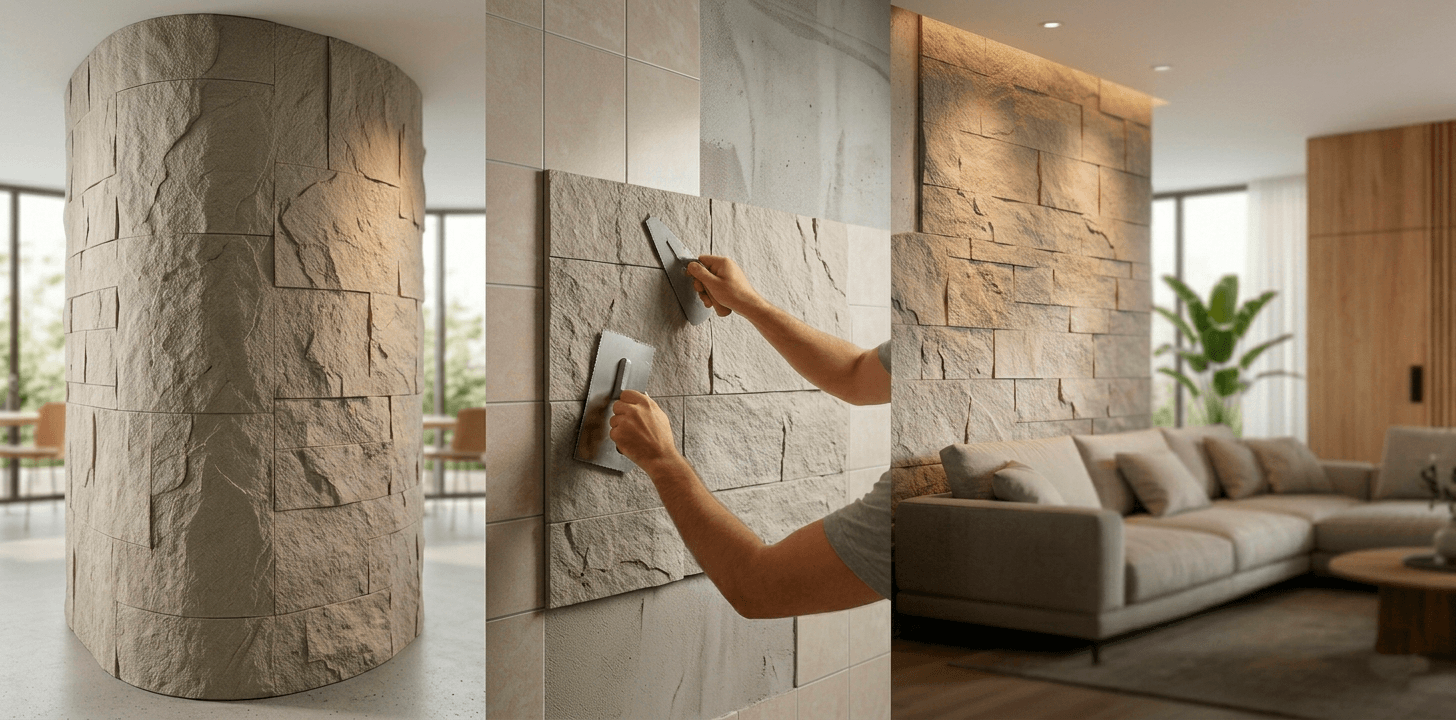
Flexible Natural Stone: What It Is, How It Works and Why It's Being Used More and More
What Is Flexible Natural Stone?
When we talk about flexible natural stone, we are not dealing with a synthetic material that imitates stone: it is real stone. The manufacturing process consists of extracting an extremely thin layer of rock — usually slate, quartzite, sandstone or mica — with a thickness ranging between 1 and 3 mm, and laminating it onto a fibreglass mesh or PVC/polyester membrane that acts as a structural support.
The result is a sheet that retains the full texture, colour and minerals of the original rock, but can be rolled up, bent at an angle and adapted to curved surfaces, columns, vaults or any complex geometry. The total weight of the installed sheet is around 2 to 4 kg/m², compared to 25–40 kg/m² for a conventional slate slab.
Technical Composition
| Layer | Material | Function |
|---|---|---|
| Top layer | Natural stone (slate, quartzite, sandstone) | Aesthetic appearance, texture and real mineralogy |
| Intermediate backing | Fibreglass or polyester mesh | Cohesion, flexibility and fracture resistance |
| Rear layer (optional) | PVC membrane or kraft paper | Additional waterproofing and easier installation |
Main Uses: Where Can Flexible Stone Be Applied?
Versatility is its strongest argument. It can be installed on virtually any flat or curved surface, both indoors and outdoors, with or without prior waterproofing.
Interior
- Living room, bedroom and hallway walls
- Bed headboards and decorative panels
- Kitchen backsplash and splashback areas
- Shower walls and wet areas (with adequate sealing)
- Column and pillar cladding
- Suspended ceilings and vaults
- Furniture, doors and drawer fronts
Exterior
- Ventilated facades and ETICS cladding systems
- Plinths and window sills
- Balconies and terraces (walls, not floors)
- Swimming pools (walls, not the floor)
- Pergolas and planters
- Vehicle and motorhome cladding
Advantages and Disadvantages vs Other Cladding Materials
✓ Advantages
- 100% natural stone, not an imitation
- Very low weight (2–4 kg/m²)
- Adaptable to curved surfaces
- Installation without construction work or dust
- Mild thermal and acoustic insulation
- Fire resistant (Class B-s1)
- Breathable (prevents condensation)
- Available in rolls: fewer joints
- Compatible with drywall and plaster surfaces
✗ Disadvantages
- Not suitable for high-traffic floors
- Requires specific sealing in wet areas
- Higher price than synthetic panels
- Natural colour variation between batches
- Requires clean and dry substrate
- Spot repairs visible if stock runs out
Flexible Stone vs Conventional Natural Stone
| Feature | Flexible Stone | Natural Stone Slab |
|---|---|---|
| Weight | 2–4 kg/m² | 25–40 kg/m² |
| Thickness | 1–3 mm | 10–30 mm |
| Curved surfaces | Yes | No (except special cut) |
| DIY installation | Feasible | Requires professional |
| Construction work needed | No | Generally yes |
| Material | Real natural stone | Real natural stone |
| Approximate price/m² | 30–80 €/m² | 40–120 €/m² |
Flexible Stone vs Stone Imitation Panels
Polyurethane or PVC panels that imitate stone are cheaper (8–20 €/m²), but they are plastic. Flexible stone contains genuine mineral, which translates into higher scratch resistance, real thermal behaviour, breathability and an appearance that far surpasses any imitation. For projects where detail matters, the difference is clearly perceptible.
How to Install Flexible Natural Stone
It is one of the easiest cladding materials to apply. No levelling compound, spacers or mortar are required. The basic process is as follows:
- Surface preparation: clean, dry, dust-free and degreased. Compatible with plaster, cement, drywall, wood, metal and previously painted surfaces (if the paint is firmly bonded).
- Cutting: with scissors, a cutter or a jigsaw. No dust, no angle grinder.
- Adhesive: contact adhesive, specific flexible stone adhesive or MS-polymer construction adhesive applied with a notched trowel (V3). On vertical walls, a silicone gun applied in points also works.
- Bonding: press the sheet onto the surface starting from one end, like a vinyl film. On curves, stretch it slightly so it follows the geometry.
- Joints: can be left open or sealed with neutral-coloured silicone or stone grout.
- Final sealing (optional): in wet areas or outdoors, apply a water repellent or stone-specific varnish that reinforces waterproofing without covering the texture.
Installation Difficulty
For flat surfaces, installation is suitable for DIY with basic experience. Curved surfaces, sharp-angle corners and shower areas require more care — in the case of showers, a professional installer is recommended to guarantee watertightness.
Maintenance: How to Care for Flexible Stone
Maintenance is minimal. Natural stone does not accumulate surface dirt like untreated porous materials. For routine cleaning, a damp cloth or water with neutral soap is sufficient. No wax or specialist products are needed.
- Weekly cleaning: damp cloth or microfibre mop.
- Stains: soapy water. For greasy stains, a few drops of mild degreaser.
- Sealing: outdoors, renew the water repellent every 3–5 years depending on exposure.
- What to avoid: concentrated bleach, acids (limescale removers), steel wool.
Durability and Long-Term Behaviour
When correctly installed and sealed, flexible stone has a lifespan of over 25 years indoors and between 10 and 20 years outdoors, depending on direct weathering exposure. The stone layer does not fade or degrade under UV light; what may deteriorate is the adhesive and the rear membrane if the wrong outdoor reference is used.
Technical Reference Classifications
- Fire resistance: Class B-s1 (low flame spread, very low smoke)
- Water vapour permeability: µ ≈ 30–50 (breathable)
- Working temperature: from −30 °C to +120 °C (without adhesive)
- Water absorption: <2% with hydrophobic treatment
- Scratch resistance (Mohs): 3–6 depending on rock type
Types of Flexible Stone: Available Materials and Finishes
| Rock type | Typical tones | Hardness (Mohs) | Recommended use |
|---|---|---|---|
| Slate | Black, grey, terracotta, green | 3–4 | Interior and exterior |
| Quartzite | White, beige, gold, red | 6–7 | Premium interior and exterior |
| Sandstone | Ochre, brown, light grey | 4–5 | Interior and sheltered areas |
| Mica / Muscovite | Silver, gold, shiny black | 2–3 | Interior, decorative |
The most common formats are rolls of 1.22 × 2.44 m (≈ 3 m²) and sheets of 1.22 × 0.61 m. Some suppliers offer formats up to 1.22 × 5 m for large projects with minimal joints.
Approximate Costs for Flexible Natural Stone
- Entry range (basic slate): 28–40 €/m²
- Mid range (premium slate, sandstone): 40–60 €/m²
- High end (quartzite, large formats): 60–90 €/m²
- Adhesive + sealant: 5–12 €/m² additional
- Labour (if subcontracted): 15–30 €/m²
Common Problems and How to Avoid Them
Edge Delamination
Occurs when the surface was not clean or an unsuitable adhesive was used. Fix with MS-polymer adhesive applied to the edges and held under pressure for 24 hours. Outdoors, always use references with UV-rated membranes.
Water Stains in Wet Areas
Caused by lack of hydrophobic sealing. The preventive solution is applying penetrating water repellent before installation in showers or on terraces.
Colour Variation Between Panels
This is an inherent characteristic of natural stone, not a defect. To minimise it, purchase all required material from the same batch and shuffle the sheets before installation, just as with parquet.
Bubbling or Warping
Usually caused by residual moisture in the substrate or excess adhesive. Let the substrate dry for at least 72 hours before installation and use the adhesive quantity recommended by the manufacturer.
Real Use Cases in Renovation and Interior Design Projects
Renovation Without Building Works in Rental Properties
Flexible stone has become a common solution for owners who want to visually renew a space without stripping existing cladding. It is applied directly over old tiles with contact adhesive, eliminating construction work, debris and mortar drying time.
Column Cladding in Commercial Spaces
Concrete pillars in hospitality and retail spaces are one of the most common use cases. The sheet wraps around the pillar with a single rear joint, with no complex cuts required.
Lightweight Facades in Buildings with Load Restrictions
In timber-framed buildings or facade renovations where no extra weight can be added, flexible stone delivers a mineral finish without compromising the structure.
Shower Wall in Small Bathrooms
In bathroom renovations in small spaces where there is no room to remove and rebuild the tiling, flexible stone is applied directly over existing tiles (if well bonded and crack-free), adding only 2–4 mm of thickness.
Frequently Asked Questions About Flexible Natural Stone
Can flexible stone be used in the shower?
Yes, but a perimeter seal with neutral silicone and a water repellent applied to the surface before installation are required. Permanent submersion is not recommended, but for shower walls it works correctly when properly sealed.
Can flexible stone be installed outdoors?
Yes, provided the reference is specifically rated for exterior use. It must have a UV-resistant membrane and joints should be sealed with exterior-grade silicone. On heavily exposed north-facing facades, renew the water repellent every 3–5 years.
What adhesive should I use to install flexible stone?
The most versatile is MS-polymer adhesive in a cartridge (solvent-free), compatible with any substrate and resistant to moisture. For very smooth substrates such as metal or glass, add a primer. In dry areas, spray contact adhesive also works.
How much does flexible stone weigh per square metre?
Between 2 and 4 kg/m² depending on the rock type and thickness. Compatible with drywall and lightweight structures without additional reinforcement.
Can it be installed over existing tiles?
Yes, as long as the tiles are well bonded and crack-free. The surface must be clean and degreased. If the tile has pronounced relief, it is advisable to level with filler before installation.
How much does flexible stone installation cost?
Material ranges from 28 to 90 €/m² depending on the variety. With professional labour, total cost is between 50 and 130 €/m². For DIY installations on flat surfaces, the only additional cost is adhesive and sealant (5–12 €/m²).
Is flexible stone a natural or artificial material?
It is real natural stone — slate, quartzite, sandstone or mica — in an ultra-thin layer on a fibreglass or polyester backing. The stone layer contains no artificial resins or pigments.
What is the difference between flexible stone and split stone?
They are names used interchangeably in the market for the same product: a natural stone sheet on a flexible backing. Some manufacturers call the stiffer formats with greater thickness (3–5 mm) "split stone", while "flexible stone" generally refers to the rollable formats of 1–2 mm.
Conclusion
Flexible natural stone solves a specific problem: installing real stone where it was previously impractical due to weight, geometry or budget. It is not an imitation. It is not a lesser substitute. It is a different way of working with the same age-old mineral material, adapted to the current requirements of construction and renovation.
Its greatest limitation is the one it shares with any wall cladding: it is not designed for high-traffic floors. In everything else — walls, columns, ceilings, facades, furniture — it delivers results that combine material authenticity, easy installation and competitive total cost compared to conventional stone.
View flexible natural stone → All wall cladding → Talk to an adviser →
Share:
Suelo vinílico SPC: qué es, cómo funciona y cuándo es la mejor opción