
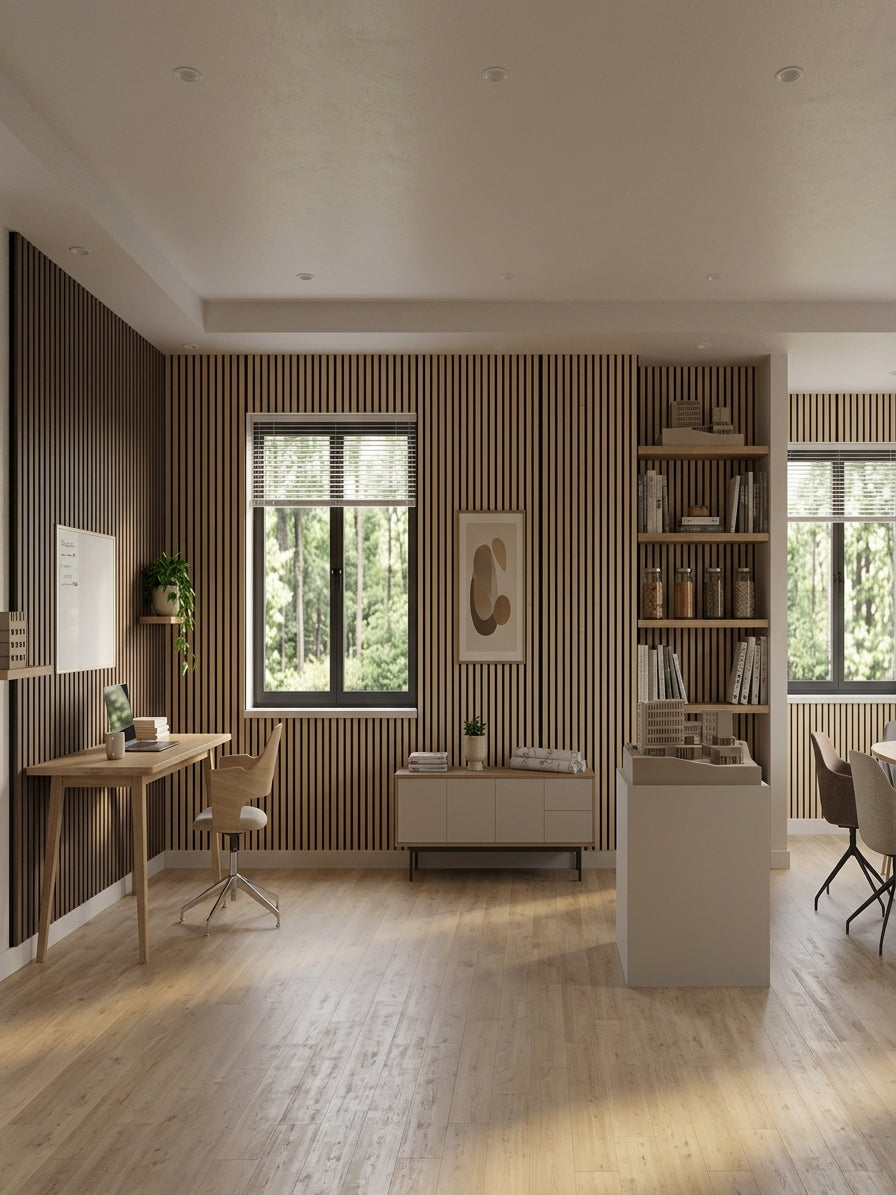
The 120 x 60 cm decorative acoustic panel performs two functions in a single piece: it corrects the room's acoustics and covers the wall with a warm wood-effect finish. Each unit covers 0.72 m² and weighs 5 kg, so one person can handle it without assistance.
The visible face reproduces the grain of light oak and adds depth and rhythm to the wall. Behind it, the absorbent structure reduces sound reflections and softens the echo typical of open-plan spaces, ceramic floors, and smooth walls. The result is noticeable as soon as you enter: conversations are easier to understand and the room no longer sounds hollow.
It can be installed on walls or ceilings made of plasterboard, brick, concrete, or existing paint. No building work, machinery, or framing is required: mounting adhesive or screw fixing is enough. We ship reference MT91003 from our warehouse in Pinto (Madrid), with permanent stock.
Technical specifications
| Specification | Data |
|---|---|
| Dimensions | 120 x 60 x 2 cm |
| Coverage per panel | 0.72 m² |
| Weight | 5 kg per piece (approx. 6.9 kg/m²) |
| Finish | Light oak wood effect on the visible face |
| Function | Acoustic absorption and decorative wall covering |
| Reference | MT91003 |
| EAN | 8435770890872 |
| Sales formats | Single unit or pack of 4 panels (2.88 m²) |
| Placement | Wall and ceiling, indoors |
| Installation | Mounting adhesive or mechanical fixing |
Quick unit calculation. Divide the square metres you want to cover by 0.72 and round up. As an acoustic guideline, treating between 20% and 30% of the wall surface is usually enough in a home. A 4 x 3 m bedroom with a height of 2.5 m has around 35 m² of wall surface: 10 to 14 panels.
Applications and uses
This decorative acoustic panel is suitable for any room where noise affects comfort or concentration. In renovation projects, it also combines two tasks in one: decorative wall covering and acoustic improvement, with a single installation. These are the most common uses among our customers:
- OfficesMeeting rooms and workstations with frequent video calls, where echo reduces speech intelligibility.
- Home studioVoice recording, podcasts, and streaming in untreated domestic rooms.
- BedroomsCustom-made headboards that decorate and absorb sound at the same time.
- HospitalityRestaurants, cafés, and waiting areas with heavy traffic and hard surfaces.
- Open-plan living roomsOpen spaces connected to the kitchen, where sound bounces around unchecked.
- Classrooms and coworking spacesTraining centers and shared spaces that need to reduce background noise.
How to install, step by step
- Prepare the surface. The wall must be firm, clean, and dry. Sand off any textured paint or loose paint and seal cracks before starting.
- Lay out the panels dry. Position the first row without adhesive and mark a level line. The first panel determines the alignment of the entire composition.
- Apply the adhesive. Apply vertical beads of mounting adhesive to the back, including a perimeter bead a couple of centimeters from the edge.
- Press and adjust. Position the piece, press evenly, and check the joint with the adjacent panel before the adhesive sets.
- Finish the edges. Cut with a fine-toothed tool and finish the joints with the corners, ceiling, and skirting board.
Check the surface before gluing. Each panel weighs 5 kg, so the paint must be firmly adhered and the partition must be in good condition. If the surface is uneven or you have doubts about its stability, screw the panels onto battens instead of gluing them. Install only in dry interiors, away from direct splashes and exposure to the elements.
Advantages and benefits
Choosing a decorative acoustic panel should not mean having to give up design. Conventional acoustic treatment looks technical and cold; these wood-effect acoustic panels provide sound control with an interior-design finish, so you can install them in the living room without making it look like a recording studio. The 120 x 60 cm format makes installation quick: you cover 2.88 m² with just four pieces and reduce the number of visible joints.
The low weight allows installation on a lightweight partition without prior reinforcement. Unlike solid wood, this decorative acoustic wall covering maintains a consistent tone between batches, which you will appreciate if you expand the covered area later. And because we work with our own stock, you receive the complete order without waiting for production. If you are looking for an alternative to exposed-fiber sound-absorbing panels, this range offers a much warmer appearance.
Available finishes
The range shares the same format and mounting system, so you can combine shades on one wall or use a single shade throughout the room.
| Finish | Reference | EAN |
|---|---|---|
| Light oak | MT91003 | 8435770890872 |
| Grey oak | MT91001 | 8435770890810 |
| Teak | MT91002 | 8435770890865 |
| Smoked walnut | MT91004 | 8435770890889 |
Compare formats and shades in the collection of decorative acoustic panels and wall coverings.
Frequently asked questions
Do decorative acoustic panels block out noise from the neighbours?
No, and it is important to distinguish between the two concepts. Sound insulation prevents sound from passing through an enclosure and requires mass or air cavities. Absorption reduces echo within the room itself. This decorative acoustic panel works through absorption: it greatly improves the room’s acoustics, but it does not eliminate noise coming from the neighbouring property.
How many acoustic panels do I need for a room?
As a guideline, cover between 20% and 30% of the wall surface. In a 4 x 3 metre bedroom with a height of 2.5 metres, the walls total approximately 35 m². You will therefore need between 10 and 14 panels. Distribute the pieces across two opposite walls for a balanced result.
How are acoustic panels installed on the wall?
Clean and level the surface before starting. Apply mounting adhesive in vertical strips to the back and press the panel against the wall. If the substrate is uneven, screw the panels onto battens. Mark a reference line with a laser level: the first panel determines the alignment of the entire arrangement.
Can acoustic panels be installed on the ceiling?
Yes, and in highly reverberant rooms, the ceiling is often the most worthwhile surface. Keep the weight of each piece in mind: on ceilings, it is advisable to combine adhesive with mechanical fastening and check that the substrate can support the load.
Our recommendation
For offices, bedrooms, or echoing living rooms, this is the panel we recommend: visible results in one afternoon, with no construction work or dust, and available as a single unit or a pack of 4 with immediate stock. Send us your room measurements and we’ll tell you how many pieces you need and how to arrange them.
Share:
3D polyurethane panels
Natural flexible stone: what it is and how to choose it